This article originally appeared in The Bar Examiner print edition, Winter 2025-2026 (Vol. 94, No. 4), pp. 19–28.

After years of research, expert input, and stakeholder feedback, the NextGen UBE is set to debut in select jurisdictions in July 2026.
This timeline, interspersed with quotations from Bar Examiner articles and other NCBE publications, highlights moments along the exam’s path to launch.
2018
January
NCBE creates the Testing Task Force. The TTF embarks on a three-year study to determine the minimum knowledge and skills newly licensed lawyers need. NCBE President and CEO Judith A. Gundersen marks the genesis of this endeavor:
“With regard to the bar exam of the future, NCBE is taking the lead on studying the competencies needed for entry-level practice in the 21st century with the creation of our Testing Task Force (TTF). While the TTF has been constituted for only about six months, the progress already made in identifying a research plan, and in choosing a consultant to assist the TTF as it moves forward with its research, is proceeding with due dispatch.”
— Judith A. Gundersen, “President’s Page,” 87(2) The Bar Examiner 3–5 (Summer 2018).
September
The TTF begins Phase 1 of its study. This phase gathers input from stakeholders—lawyers, legal educators, bar administrators, and others—about the current bar exam and its relevance to modern law. Gundersen writes:
“In terms of successes, we are very pleased with the progress made thus far by the Testing Task Force. We appointed the Task Force at the beginning of this year to undertake a three-year study to ensure that the bar examination continues to test the knowledge, skills, and abilities required for competent entry-level practice in the 21st century. In September we had meetings with our independent research consultants to commence the first phases of the study. We are committed to devoting significant resources to this study to ensure that it is comprehensive and empirical, and that stakeholder input is obtained.”
— Judith A. Gundersen, “President’s Page,” 87(3) The Bar Examiner 3–6 (Fall 2018).
November
The first listening session is held for Phase 1. Michele A. Gavagni, then-chair of NCBE’s Board of Trustees, reflects on this milestone:
“In November, the Task Force published a summary of its research plan and the study timeline on its website and held its first listening session on the bar examination at the Council of Bar Admission Administrators’ Fall Meeting in Denver. It is the goal of the Task Force to be collaborative, soliciting input from state bar admitting authorities, legal educators, legal professionals, and other stakeholders, in recognition of a shared objective of ensuring the protection of the public and the readiness of new lawyers to join the profession.”
— Michele A. Gavagni, “Letter from the Chair,” 87(4) The Bar Examiner 1–2 (Winter 2018–2019).
2019
Fall
The TTF commences Phase 2 of its three-year study: a nationwide practice analysis to better understand newly licensed lawyers’ tasks and responsibilities in the 21st century. Over 14,000 practicing lawyers across 56 US jurisdictions completed the survey. Gundersen comments,
“The Testing Task Force also met throughout the summer and, with the help of consultant ACS Ventures LLC, developed, field-tested, and deployed its nationwide practice analysis, representing Phase 2 of the Task Force’s study. A practice analysis is the basis for developing test blueprints and test design in a licensing context. While neither novel nor groundbreaking, a practice analysis is the established best practice when considering changes to a high-stakes licensing test. It is a necessary part of any testing program validation and/or redesign endeavor.
The Task Force’s practice analysis, which ran from August 1 through late September, was open to licensed lawyers who had at any point in their careers supervised newly licensed lawyers. We have collected a wealth of demographic information—such as practice area, firm size, geographic area, gender, race, and ethnicity—and are in the process of slicing and dicing (technical terms!) all the data we have received. The data will give us more information about how the practice of law for newly licensed lawyers differs, for instance, across regions and among different kinds of firms.”
— Judith A. Gundersen, “President’s Page,” 88(3) The Bar Examiner 4–6 (Fall 2019).
2021
January
The TTF releases its preliminary recommendations for the next generation of the bar exam and presents them to legal educators and bar admissions authorities. Near the end of January, NCBE’s Board of Trustees approves the finalized recommendations.
Board approval marks the completion of Phase 3 and of the TTF’s overall study.
March
Gundersen announces implementation of the TTF’s recommendations. Data from the three-year study will inform the initial content scope of the future bar exam. She writes,
“The Task Force’s three-year study of the bar exam began in January 2018 and was completed on schedule thanks to the extraordinary leadership of Judge Cindy Martin and Task Force members Bucky Askew, Diane Bosse, David Boyd, Anthony Simon, and Timothy Wong—all of whom are current or former NCBE Board of Trustees members and have decades of admissions-related experience. They were ably assisted by NCBE staff members Kellie Early, Chief Strategy Officer, and Danielle Moreau, Strategic Initiatives Manager, and by Dr. Mark Raymond, Director of Assessment Design and Delivery, who joined our staff in September 2019. We are indebted to all of them and grateful for their engagement, wisdom, and hard work.
We are now poised to begin the significant undertaking of implementing the recommendations. The Testing Task Force sunsetted at the end of March, and a new group of NCBE volunteers and staff members is now leading the implementation effort….
We will continue to include input from stakeholders and invite participation by members of the bar admissions and legal education communities as we undertake the exciting and important work over the next four to five years of building the next generation of the bar exam.”
— Judith A. Gundersen, “President’s Page,” 90(1) The Bar Examiner 3–5 (Spring 2021).
June
NCBE announces the formation of the Content Scope Committee—a group of 21 deans, legal educators, bar examiners, and practitioners tasked with defining the doctrinal knowledge and skills to be tested on the new exam. Kellie Early, former Chief Strategy Officer at NCBE, writes about the new committee:
“The members of this diverse, cross-disciplinary committee are working through this fall to develop the draft test content specifications for the next generation of the bar exam based on the Testing Task Force’s recommendations. The focus for determining content will be on what knowledge and skills entry-level lawyers need to practice competently.
The Content Scope Committee is tasked with delineating the scope of coverage of the Foundational Concepts and Principles and the Foundational Skills designated for inclusion on the new exam for purposes of producing the test ‘blueprint’ or content specifications, which will be used to write appropriate test items and to inform applicants, law schools, and jurisdictions of the coverage on the exam.”
— Kellie Early, “The Next Generation of the Bar Exam: Quarterly Update,” 90(2–3) The Bar Examiner 49–50 (Summer/Fall 2021).
2022
Spring
NCBE begins drafting item sets for pilot testing. Each set, which includes a mixture of multiple-choice and written questions, is based on a common fact scenario and may provide examinees with legal resources and/or supplemental documents. Early marks this milestone:
“A few item set prototypes are ready for pilot testing! We plan to do some limited pilot testing of item sets this summer before expanding these efforts in the fall. During pilot testing, some students will be provided with relevant legal resources (e.g., redacted rules), and some will be instructed to answer without access to resources so that performance variances in and between the two groups can be analyzed.”
— Kellie Early, “The Next Generation of the Bar Exam: Quarterly Update,” 91(1) The Bar Examiner 59–60 (Spring 2022).
March
NCBE releases the preliminary Content Scope Outlines for public comment and announces that the future bar exam will holistically test doctrinal knowledge and lawyering skills. This initial scope includes eight foundational concepts and principles and seven foundational skills.1
Dennis C. Prieto, Professor and Reference Librarian at Rutgers Law School, served on NCBE’s Content Scope Committee, which was instrumental in developing the holistic approach to bar examination. He writes:
“By acknowledging that the successful practice of law requires both skill and knowledge, and by testing practical skills as part of its assessment, the NextGen bar exam will help address one of the current divisions in legal academia: the emphasis on doctrine over the importance of lawyering skills. Doctrine, to be sure, is an essential aspect of legal learning and practice; indeed, the NextGen bar exam explicitly announces its doctrinal core: its collection of eight Foundational Concepts and Principles, those on which the new exam will most test each candidate’s competency. But one must acknowledge that to successfully attend to client needs, each doctrinal subject relies upon skillful practice to maximize the investigation, client counseling, writing, or research-indicated outcomes most likely to achieve positive outcomes for clients….
I have been teaching at the college and university level since 1992. From my perspective, an evaluation that mimics aspects of practice is better than one that simply asks about measurable facts inherent in a given study or doctrine. It measures more by assessing both skill and doctrine. And by telling us more, it is a more useful tool, especially for those who write and study about student performance on professional certification. From my professional experience serving on the NextGen Content Scope Committee (and currently, on the NextGen Tasks and Rubrics Advisory Committee), I am confident that the NextGen bar exam will be able to measure those aspects of competency that we will expect newly licensed lawyers to meet and exceed.”
— Dennis C. Prieto, “From My Perspective: Essays on the NextGen Bar Exam and Legal Education,” 92(2) The Bar Examiner 24–31 (Summer 2023).
Fall
NCBE chooses to deliver the new exam via examinees’ laptops at jurisdiction-managed testing sites rather than computer testing centers. In a quarterly update, Early weighs the benefits and drawbacks of both delivery methods:
“The new exam will be delivered on computers rather than paper, and NCBE has been exploring the two options of administering the new exam: at computer testing centers or on examinees’ laptops at jurisdiction-managed sites. There are advantages and drawbacks to each of these options. Although the use of testing centers would provide more uniform testing conditions and computer equipment, it would also require a larger bank of test questions to produce comparable test forms over the longer testing window necessitated by seating capacity constraints. The use of laptops at jurisdiction-managed sites would permit us to continue the current ‘event-based’ administration schedule, which does not require as large of a question bank, but it provides less uniformity of testing conditions and equipment.”
— Kellie Early, “The Next Generation of the Bar Exam: Quarterly Update,” 90(4) The Bar Examiner 31–33 (Winter 2021–2022).
Jurisdictions that adopted the NextGen UBE in 2023
Maryland, Missouri, Oregon, Wyoming, Connecticut, Iowa, Arizona, Kentucky, and Nebraska

2023
May
The Content Scope Committee publishes the finalized Content Scope Outlines.
Summer
NCBE publishes samples of NextGen question types. Beginning with the July 2026 administration, examinees will answer essay questions, short-response questions, integrated question sets, multiple-choice questions with one correct response, and multiple-choice questions with a possibility of one or more correct responses.
Beth E. Donahue, who was NCBE’s Director of Content Innovation and Education Relations at the time, says the following:
“Integrated question sets represent the biggest change to the way questions are presented on the bar exam…. Examinees will be presented with scenarios that are consistent with the types of cases they’ll likely see within the first three years of their practice, along with the documents they’d expect to see as they approach those cases. Both the doctrinal law and the skills that they’ll need to demonstrate are carefully calibrated to ensure that examinees must engage thoroughly with the materials and utilize the full set of fundamental skills identified in our nationwide research as essential for new attorneys.”
— Beth E. Donahue, “NCBE Publishes First Samples of New Question Types for NextGen Bar Exam” (July 11, 2023), available at https://www.ncbex.org/news-resources/ncbe-publishes-first-samples-new-question-types-nextgen-bar-exam.
Mike Gianelloni, Managing Editor for the NextGen bar exam, adds:
“The multiple-choice questions on the NextGen exam are exciting in several ways that may not be immediately apparent…. The new multiple-choice questions test legal issue spotting in a way that reflects the complexity of legal issues found in practice, where a matter of criminal law, for example, may have associated evidentiary and procedural issues. Today we might test those concepts separately, but on the NextGen exam they can be combined. The subsets of multiple-choice questions that are included within integrated question sets are even more exciting: there, we are using multiple-choice questions to assess practical skills, like client counseling and dispute resolution.”
— Mike Gianelloni, “NCBE Publishes First Samples of New Question Types for NextGen Bar Exam” (July 11, 2023), available at https://www.ncbex.org/news-resources/ncbe-publishes-first-samples-new-question-types-nextgen-bar-exam.
Law professors comment on how the Content Scope Outlines might affect their curriculum and teaching methods. A professor from Samford University’s Cumberland School of Law, Timothy J. McFarlin, shares his opinion on the shift away from memorization toward a more “open book” exam delivery mode:
“In the context of a bar exam, pure memorization is rigorous only in the abstract; practicing lawyers rarely utilize it. Truly realistic rigor—the kind that lawyers encounter—involves much more, and much more of that ‘more’ is reflected in the NextGen approach….
First, I think it will make testing more practical. Teachers commonly use sample bar-exam (or bar-exam ‘style’) questions in class and on exams. We do this for the sensible reason that such questions help test students’ knowledge in a way that prepares them for the type of questions they’ll encounter on the bar. Using the newer NextGen-style questions in law school will help narrow the gap between readiness for the bar exam and readiness for practice.
Second, I expect it will encourage more source-utilization in testing, such as allowing students to read and apply a statute during an exam. Traditionally, many law school exams are ‘closed book,’ i.e., requiring the memorization of all sources of law, such as rules, cases, and statutes. There can be good reasons for this, particularly if a teacher determines it’s the best way for students to learn the material. As I mentioned above, some differences between education and practice are natural. I just think that ‘because you have to memorize sources for the bar exam’ is an artificial reason, and many of us understandably fall under its sway. That’s why I think the NextGen approach will naturally nudge teachers toward exams that, where possible, will encourage students to use sources as lawyers do—by looking at them….
Third, I anticipate that the NextGen approach will help teachers and students draw more connections between courses. The practice of law regularly spans multiple fields. A lawyer defending a tort claim must also consider a client’s potential criminal liability and how settlement communications may be contractually binding. A lawyer drafting a document waiving liability must consider contract and tort law. And so on. The NextGen’s testing of several fields in a single question set will encourage making these connections early and often in law school courses.”
— Timothy J. McFarlin, “From My Perspective: Essays on the NextGen Bar Exam and Legal Education,” 92(2) The Bar Examiner 24–31 (Summer 2023).
August
NCBE announces the length and structure of the NextGen bar exam. The total duration will decrease from the current exam’s 12 hours to just 9, which will be divided into three sessions of 3 hours each. Six hours of testing time will occur on the first day, with the remaining 3 on the second.
Marilyn J. Wellington, former Chief Strategy and Operations Officer for NCBE, details the benefits of this new length and structure:
“We accomplish this reduction in testing time with an exam design that is more efficient in measuring examinee readiness to enter the practice of law. The shift from 12 to 9 hours of testing will bring multiple benefits, including allowing jurisdictions a window on the second testing day to administer a local exam to be scaled to the NextGen exam, in the same manner that some jurisdictions now scale a local exam to the MBE. For other jurisdictions, it offers the possibility of administering a separate and distinct local law component test….
Unlike the current exam, which is subdivided by type of question, the NextGen exam will feature a mix of all three question types in each of its 3-hour sections, providing a balanced and integrated experience for examinees throughout the exam….
One new question type we are particularly excited about is a multiple-choice question—sometimes called ‘multiple-select’—in which examinees will be given six answer options rather than the traditional four and will then be required to choose two correct answers rather than the traditional one. This new type of question is not just a minor variation on the standard four-option version. To receive full credit for their response, an examinee must select both correct answers; it may be easier to think of it as a question that requires a two-part answer. These questions allow for more complex responses that better reflect the realities of practice (for example, there is rarely only one legal topic at issue in a case). They also provide more nuanced and valuable information about the examinee’s knowledge and skills, depending on whether the examinee chooses only one of the correct answers, both of them, or none.”
— Marilyn J. Wellington, “The Next Generation of the Bar Exam: Quarterly Update,” 92(3) The Bar Examiner 32–34 (Fall 2023).
Fall
Law schools welcome the incoming class that will have the first opportunity to take the NextGen bar exam.
October
Family law is added to the list of foundational concepts and principles. Examinees will be tested on family law starting with the July 2028 NextGen administration.
NCBE announces that the current bar exam will sunset after the February 2028 administration. Both the current and NextGen bar exams will run concurrently from July 2026 to February 2028.
November
The first jurisdictions adopt the NextGen bar exam. Several bar examiners express their approval of the new exam, citing it as a valuable tool that will help protect the public:
“Maryland is excited to be able to announce now our intention to adopt the NextGen bar exam beginning in July 2026, providing our law schools with ample notice so that they can begin preparing for the change. We believe the NextGen exam will be a valuable tool for helping ensure that every newly licensed attorney in Maryland is ready to begin practicing law.”
— Jeff Shipley, “First Jurisdictions Announce Plans to Adopt NextGen Bar Exam” (November 1, 2023), available at https://www.ncbex.org/news-resources/first-jurisdictions-announce-plans-adopt-nextgen.
“Missouri has long been a leader in embracing forward-thinking enhancements in attorney licensure, including being the first state to adopt the concept of a portable bar examination score with the Uniform Bar Examination…. That proud tradition continues with Missouri’s commitment to be among the first states to administer the NextGen bar examination in July 2026. Missouri’s decision reflects trust and confidence in the research underlying development of the NextGen bar exam, which will emulate a ‘day in the life’ of a lawyer by integrating the assessment of core lawyering skills and foundational doctrine, consistent with the expectations of a newly licensed lawyer securing a general license to practice law in the interest of public protection.”
— Hon. Cynthia L. Martin, “First Jurisdictions Announce Plans to Adopt NextGen Bar Exam” (November 1, 2023), available at https://www.ncbex.org/news-resources/first-jurisdictions-announce-plans-adopt-nextgen.
“This new model of bar exam is consistent with Oregon’s high standards and emphasis on protecting the public by assessing an applicant’s legal skills and knowledge…. This model will ensure that new Oregon attorneys are practice-ready when they join our bar.”
— Lee Ann Donaldson, “First Jurisdictions Announce Plans to Adopt NextGen Bar Exam” (November 1, 2023), available at https://www.ncbex.org/news-resources/first-jurisdictions-announce-plans-adopt-nextgen.
Jurisdictions that adopted the NextGen UBE in 2024
Utah, Vermont, Guam, Kansas, New Mexico, Minnesota, Colorado, Washington, Tennessee, Illinois, Oklahoma, Florida, Georgia, Indiana, West Virginia, North Dakota, Northern Mariana Islands, Alaska, Virginia, and South Dakota

2024
January
NCBE announces that AccessLex Institute, a nonprofit dedicated to making legal education more accessible, will help develop NextGen study aids for candidates.
Spring
Candidates who took the February 2024 bar exam take part in a prototype exam, which has a pivotal role in setting a passing score range for the NextGen exam:
“Besides providing an opportunity for administrators and NCBE to gain additional experience with the NextGen bar exam design and procedures, the prototype exam serves another critical goal: determining the relationship of the new exam to the current one. That, in turn, will provide the key to determining the equivalent passing scores between the two exams.”
— Andreas Oranje, PhD, MBA, “Quarterly Update: NextGen Development Forges Ahead with Prototype Exam on the Horizon,” 93(1) The Bar Examiner 68 (Spring 2024).
June
NCBE publishes a research brief analyzing data collected during the pilot testing phase. The following are conclusions reported in the research brief:
“…the study found that participants had positive responses to the new NextGen question types and test format. Participants especially noted that the questions had more relevance to their professional lives, both as early-career attorneys and interns, and better tested skills that practicing attorneys use….
Based on feedback on survey questions, most pilot test participants (between 92% and 100%) indicated that they found the question sets and standalone questions to be of reasonable difficulty (i.e., neither extremely easy nor extremely difficult)….
…[Federal Rules of Evidence] participants generally spent more time than non-FRE participants answering questions requiring FRE knowledge, suggesting that access to such legal resources slows response time without increasing examinee scores. Participants also indicated that they used the FRE materials mostly for checking, rather than composing, their answers. These findings supported the decision to exclude access to additional legal resources from the NextGen bar exam….
The results from the group analysis suggest that the new question types yield similar results across different groups of participants, reducing performance gaps between them. Although we found patterns of group differences in scores for factors such as disability status, exam accommodations status, non-native English-speaking status, race/ethnicity, and gender, the magnitude of these differences varied by group and question type. For example, differences between men and women were almost nonexistent for short-response questions. Differences based on being a non-native English speaker were considered small…. Performance differences were small for other variables as well; being first in one’s family to receive a bachelor’s degree or first in one’s family to attend law school had no effect on performance for these question types.”
— NCBE, “The Testing Column: NextGen Research Brief: Pilot Testing,” 93(2) The Bar Examiner 43–48 (Summer 2024).
July
The public is invited to comment on the preliminary family law subject matter outline.
October
NCBE publishes field test results. Over 4,000 recent law graduates and final-year law students from 88 US law schools completed two hours of test content that’s set to appear on the NextGen bar exam. The research brief reveals insights on performance differences among subgroups and the experience of grading the new exam:
“Group differences based on participant demographics and Foundational Skills were found among recent graduates; however, all the differences are considered small effects….
The most significant change to grading from the current Uniform Bar Exam (UBE) to the NextGen bar exam may be the switch from today’s relative grading model, which is applied within each jurisdiction independently (albeit with standardized grading materials), to an objective, absolute grading model applied across all jurisdictions. Both are fair, psychometrically valid approaches, but absolute grading rubrics are significantly more straightforward for graders….
Results suggest that the structured nature of the NextGen bar exam grading materials allowed graders to better align participant answers with the grading criteria, potentially leading to fairer and more accurate assessments. The more flexible approach in use for the current exam allows for grader discretion but may result in less consistency and clarity in evaluating examinee performance….
…once graders are acclimated to the NextGen question types and absolute grading methods, double-grading the NextGen bar exam is expected to take the same number of grader hours as single-grading the current UBE.”
— NCBE, “NextGen Research Brief: Field Test,” 93(4) The Bar Examiner 7–14 (Winter 2024–2025).
Jurisdictions undergo prototype testing—a full-length replica of the NextGen question types and exam duration. Kara Smith, NCBE’s Chief Product Officer underscores the significance of this testing phase:
“One of our most significant milestones this year has been the NextGen prototype test, an extensive and highly detailed simulation of the full exam experience. The prototype test involved over 2,000 participants across 36 test sites in 32 jurisdictions, making it one of the most extensive trials in NCBE’s history. All participants completed the July 2024 bar exam, enabling us to draw comparisons between the two exams. This test was essential for evaluating how well the new exam structure and content align with our goals.”
— Kara McWilliams [Smith], “Quarterly Update: The Evolution of the Bar Exam: An Update from NCBE’s New Chief Product Officer,” 93(3) The Bar Examiner 32–34 (Fall 2024).
November
NCBE releases the finalized version of the family law subject matter outline.
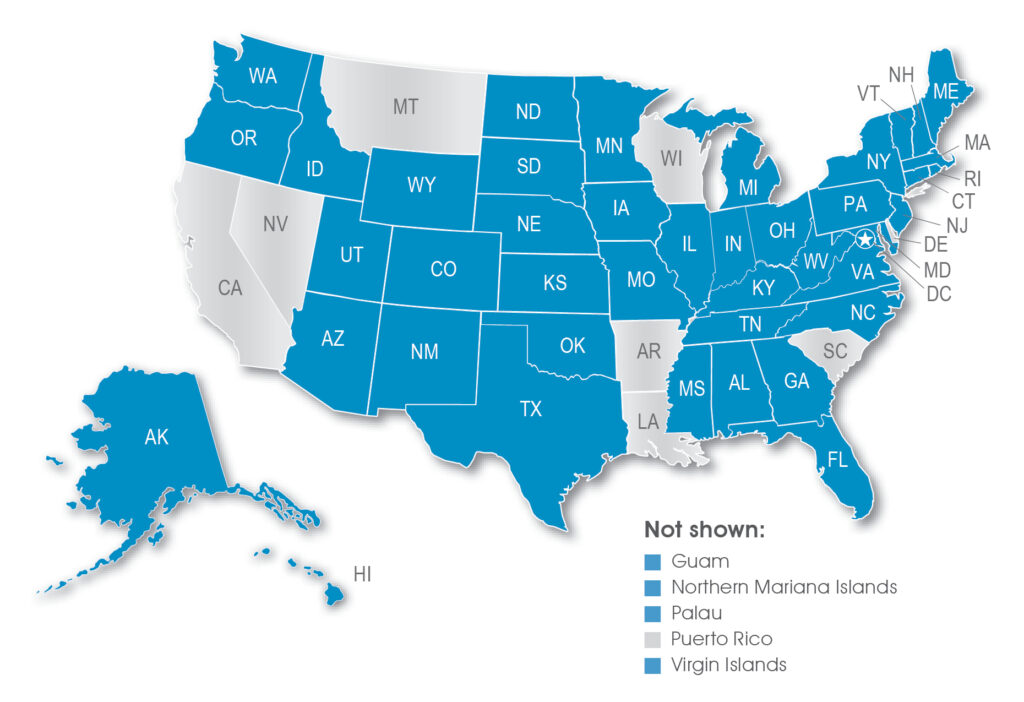
Jurisdictions that adopted the NextGen UBE in 2025 and 2026
Maine, Hawaii, New York, Idaho, Washington DC, Ohio, Texas, Massachusetts, Virgin Islands, Delaware, Rhode Island, Palau, New Hampshire, Mississippi, Alabama, Pennsylvania, Michigan, New Jersey, and North Carolina
2025
Smith announces the creation of the User Experience (UX) Division and explains its critical role in promoting a fair, valid exam that accurately measures an examinee’s competence to practice law:
“Among the transformative changes NCBE has introduced is the creation of a dedicated User Experience (UX) division, led by Jaclyn Stanislaus, NCBE’s Director of User Experience in Product Development. This division represents our commitment to making the NextGen bar exam not only rigorous and fair but also accessible, intuitive, and equitable for all test takers.
UX is a critical component of any assessment’s overall validity narrative. A seamless, well-designed experience eliminates barriers that might otherwise interfere with test takers’ ability to demonstrate their true competencies. By foregrounding UX, we enhance not only the usability of the exam but also the defensibility of the inferences drawn from candidate performance….
Overall, examinees were very positive, with one examinee sharing: ‘As someone with major test anxiety for standardized testing, this exam was much more digestible and took a lot of stress off of me while taking. This exam seemed to be more accurate as far as actual law practice [and] welcoming to the practice.’”
— Kara McWilliams [Smith], “Quarterly Update: The NextGen Bar Exam: Enhancing Validity with User Experience,” 93(4) The Bar Examiner 21–23 (Winter 2024–2025).
Spring
NCBE announces that the NextGen bar exam will be double graded to reduce grader bias and pressure while simultaneously providing a more thorough, rigorous assessment of examinees’ knowledge and lawyering skills. Adjudication will be provided to settle grader discrepancies as well. Smith writes,
“A fair, accurate, and defensible exam scoring process is just as critical as the bar exam itself. In high-stakes testing, every score must reflect a candidate’s true proficiency, free from bias, inconsistency, or unnecessary stress. That’s why the NextGen bar exam will go through rigorous double grading, where two jurisdiction graders review every constructed response independent of one another, with adjudication (a resolution process when two graders’ scores disagree beyond established thresholds) as needed, ensuring that every such exam item gets evaluated with precision and fairness….
NCBE actively gathered grader feedback to refine our approach. They appreciated having a second review, noting that it reduced pressure and ensured fairness. Team leaders valued the adjudication process, as it resolved discrepancies efficiently and equitably. One grader shared that the double-grading process gave them confidence that every candidate’s response was evaluated fairly and accurately. Knowing another expert validated their work and that adjudication was available made the process feel rigorous yet supportive.”
Kara McWilliams [Smith], “The NextGen Bar Exam: Quarterly Update: Raising the Bar on Score Validity with Double Grading,” 94(1) The Bar Examiner 56–59 (Spring 2025).
April
The bar exam of the future gets its official name: the NextGen Uniform Bar Examination. The current bar exam is henceforth referred to as the legacy UBE. Gundersen makes the announcement:
“It’s now official—the NextGen bar exam is the NextGen Uniform Bar Examination. As of the date this magazine went to press, 39 jurisdictions, representing over two-thirds of test takers across the United States, have adopted the new bar exam.
From now until 2033, NCBE will refer to the current UBE as the ‘legacy UBE’ to distinguish it from NextGen; from 2033 on, the new exam will simply be called the UBE. Why 2033? That’s the last year that we anticipate current UBE jurisdictions will accept legacy UBE scores for transfer.”
— Judith A. Gundersen, “President’s Page,” 94(1) The Bar Examiner 3–4 (Spring 2025).
May
Panelists meet in Chicago for a three-day standard-setting study with the goals of defining the minimally qualified candidate to practice law and solidifying a NextGen passing score range to better inform jurisdictions’ decision-making processes. Gundersen emphasizes the study’s importance:
“The Standard-Setting Study provided NCBE with important data to help advise jurisdictions on where to set their NextGen UBE passing standard (NextGen scores will be reported on a new score scale, distinct from the legacy UBE’s) and to set the concordance between the current exam passing standard and the new NextGen scale….
Setting appropriate passing scores is crucial for maintaining the integrity and quality of the bar admissions process, ensuring that those who possess the necessary knowledge and skills are licensed and not denying any who demonstrate minimal competence. Over the course of two and a half days, panelists reviewed current scoring methodologies, discussed best practices, and considered various perspectives to arrive at a definition of minimal competence and a set of performance ratings.”
Judith A. Gundersen, “President’s Page,” 94(2) The Bar Examiner 4–5 (Summer 2025).
June
NCBE publishes the July 2026–February 2027 Blueprint for the NextGen UBE. This blueprint will inform curriculum changes in US law schools as students prepare to take the bar exam. In a press release, Smith is quoted saying,
“We are pleased to be able to share this new resource to help legal educators support their students as they prepare for the first administrations of the NextGen UBE…The details found in the Blueprint are grounded in data we’ve gathered over thousands of hours of development and pretesting; they are designed to provide clear guidance for educators and candidates preparing for the NextGen exam.”
— Kara McWilliams [Smith], “NCBE Publishes NextGen UBE Blueprint for July 2026–February 2027, Legal Research Performance Task” (June 3, 2025), available at https://www.ncbex.org/news-resources/ncbe-publishes-nextgen-ube-blueprint-july-2026-february-2027-legal-research.
August
NCBE publishes the Official Examinees’ Guide to the NextGen UBE for July 2026 through February 2027. Regarding these materials, Gundersen says,
“…NCBE is providing a comprehensive toolbox for examinees preparing to take the NextGen UBE…With detailed information about what will be tested and extensive tools to help examinees prepare for exam day, this suite of resources will be an invaluable help to examinees and those who work with them as they prepare for the first administrations of the NextGen UBE.”
— Judith A. Gundersen, “NCBE Publishes Official Examinees’ Guide and Updated Content Scope for NextGen UBE” (August 1, 2025), available at https://www.ncbex.org/news-resources/ncbe-publishes-official-examinees-guide-and-updated-content-scope-nextgen-ube.
Fall
NCBE releases its final standard-setting recommendations to jurisdictions, helping them set passing score ranges ahead of the July 2026 launch.
September
NCBE publishes the first of its official NextGen UBE practice sets delivered on the real exam’s digital platform. Each includes 3 hours of authentic content and question types. Four sets are available as of December 2025, with additional study aids to come in 2026.
In collaboration with West Academic, NCBE publishes the first of its Sourcebooks series that serves as a companion to the NextGen UBE Content Scope. The initial Sourcebooks will be published through early 2026, with future updates published as needed.
2026
January
NCBE administers the Beta test to approximately 1,500 examinees who sat for the July 2025 bar exam. The Beta test is a full-scale simulation of the NextGen UBE designed to gather data across exam stages, from candidate registration to post-exam reporting.
July
The NextGen UBE debuts in select jurisdictions.
July 2026–February 2028
The legacy UBE and NextGen UBE are administered concurrently.
2028
February
The legacy UBE is administered for the last time.
July
Family law is added to the NextGen UBE as the ninth foundational concept and principle.
The NextGen UBE timeline won’t stop there. Just as it has for decades, NCBE looks forward to continuously improving and serving examinees, jurisdictions, and the wider bar admissions community in the years ahead.
Note
- The foundational concepts and principles include Torts, Evidence, Real Property, Civil Procedure, Contract Law, Constitutional Law, Criminal Law, and Business Associations. The NextGen UBE will test the following skills: Legal Research; Legal Writing; Issue Spotting and Analysis; Investigation and Evaluation; Client Counseling and Advising; Negotiation and Dispute Resolution; and Client Relationship and Management. (Go back)
Contact us to request a pdf file of the original article as it appeared in the print edition.