By Troy A. Eid
“A Bar Association of Our Own”
In 1978, a spirited group of younger Diné (Navajo) attorneys and tribal court advocates created the Navajo Nation Bar Association (NNBA). Founding NNBA members included four future Navajo Supreme Court justices (Robert Yazzie, Tom Tso, Raymond Austin, and Homer Bluehouse) and two future Navajo Nation presidents, Peterson Zah and Albert Hale.
Hale served as the NNBA’s founding president. This was just one year after graduating from the University of New Mexico Law School in 1977, where he and Yazzie had been part of the inaugural Pre-Law Summer Institute (PLSI), a program that continues to support aspiring Native American lawyers to this day.1 A frequent speaker at NNBA conferences, Hale—who served as Navajo Nation president before being elected to the Arizona General Assembly—described the original NNBA Bar Exam held in 1978 as one page of multiple-choice questions that took fewer than 30 minutes to complete and grade. “We wanted a bar association of our own, so we started having meetings to write bylaws and an exam,” he recalled over four decades later.2
Adopting a State Bar Exam Framework
Broader changes came after the Navajo Nation Council, the tribe’s legislative branch of government, established the Navajo Supreme Court in 1985.3 The Navajo Supreme Court and District Courts (known collectively as the Navajo Judicial Branch) replaced a legacy judicial system called the Court of Indian Offenses, which for more than a century had been imposed, staffed, and tightly administered by the federal Bureau of Indian Affairs (BIA), an agency of the US Department of the Interior.4
As the Nation expanded its judicial capacity independent of federal control, the Navajo Supreme Court and District Courts shifted the legal rules of decision away from Anglo-American law and toward traditional Navajo law. Since 1991, the Navajo Judicial Branch has officially recognized this body of law, called Navajo Fundamental Law or Diné Bi Beenahaz’aanii,5 as the primary means of interpreting, adjudicating, and resolving legal disputes. The common law of the Navajo courts, and especially the Navajo Supreme Court, consists primarily of published cases that have the effect of codifying previously unwritten Navajo law, often using words and phrases directly from the Navajo language.
Despite the courts’ embrace of Diné Bi Beenahaz’aanii, the NNBA Bar Examination still relies primarily on a state bar framework, albeit with considerable emphasis on Navajo Fundamental Law and other rules of decision unique to the Nation. In the late 1980s, the Navajo Judicial Branch insisted on raising and enforcing professional standards for legal practice, which led the NNBA to eliminate its short multiple-choice test for membership and develop a more comprehensive eight-hour written bar examination. The exam’s basic framework, which combines multiple-choice and essay questions, has endured for the past four decades. Current tested topics are listed below.
A score of 70 percent or better is required to pass the NNBA Bar Exam, which is held in-person twice per year at one location on or near the reservation, in March and August. Examinees may use laptops or write by hand. In addition to passing the test, applicants must satisfy different criteria depending on whether they are enrolled members of a federally recognized Native American or Alaska Native tribe:
- Nontribal members must present proof of graduation from an American Bar Association–accredited law school and of admission to practice in a US jurisdiction; they must also be in good standing with said jurisdiction.
- In contrast, enrolled members of a federally recognized Indian tribe do not need to be admitted to practice in a US jurisdiction. These candidates are eligible for NNBA membership if they have graduated from an ABA-accredited law school; if they have earned a four-year bachelor’s degree from an accredited institution; or if they have completed a paralegal training program, advocacy program, apprenticeship program, or equivalent, which is certified by the NNBA Training Committee.6
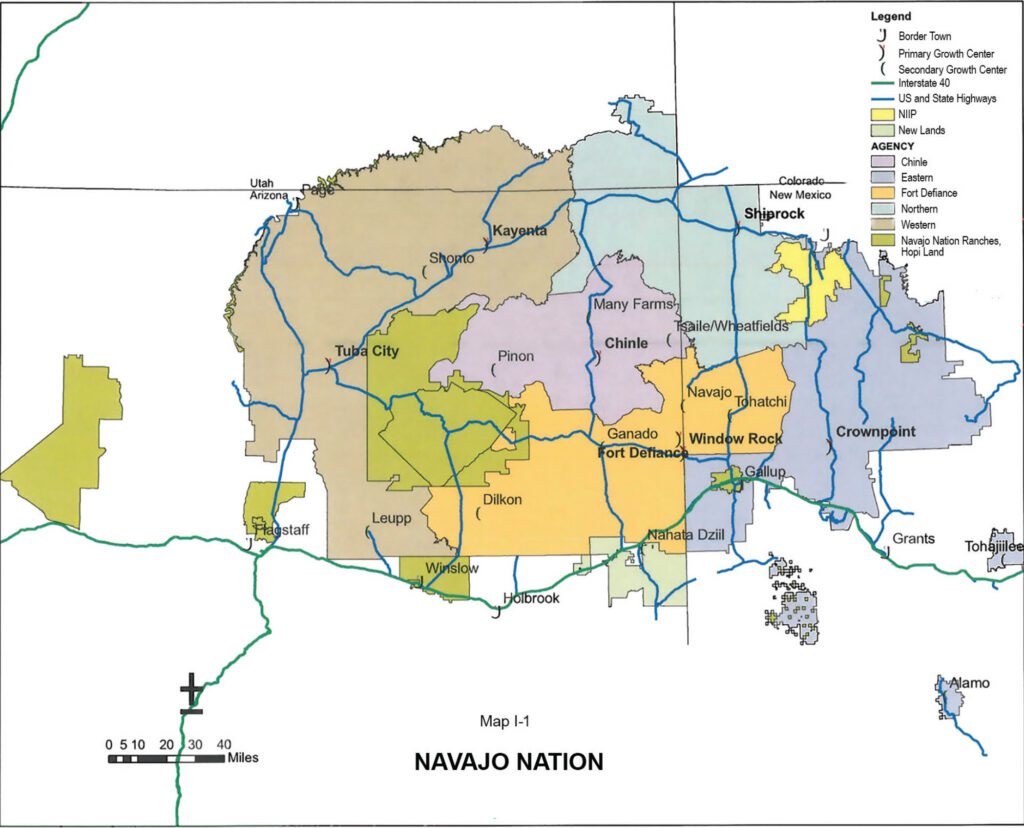
Source: Navajo Nation Office of Standards, Curriculum, and Assessment Development
Additionally, all candidates for bar membership must complete an NNBA-approved “Traditional Teachings” course to learn more about Navajo Fundamental Law, as well as topics such as Navajo Peacemaking, a traditional form of dispute resolution.
As the semiannual bar exams approach, NNBA’s Training Committee plans and teaches a weeklong bar review course, offered with hybrid options, to help candidates prepare for the test. The Training Committee is one of several NNBA committees that inform and regulate legal practice by and among the association’s members. The NNBA Admissions Committee writes new questions for every exam and grades them. NNBA’s CLE Committee plans and oversees continuing legal education requirements—CLE credits must be earned and reported annually by all NNBA members—while the Disciplinary Committee addresses alleged member misconduct.7 The Rules Committee and Judicial Evaluation Committee round out the committee roster. The association itself is directed by an elected president and vice president with guidance from a geographically elected oversight board, the NNBA Board of Bar Commissioners.
Perhaps one of the most unique aspects of NNBA membership is its mandatory pro bono requirement. There is no minimum requirement, but each NNBA member is required to accept court appointments in civil and criminal cases upon the Navajo Judicial Branch’s request. These cases can sometimes take NNBA members outside their comfort zones. For instance, a partner with the Phoenix office of a national law firm—an outstanding employment and labor law expert with no prior criminal law experience—was appointed to defend a Navajo individual charged with first-degree murder under the Navajo Law and Order Code. In another instance, a Denver attorney was appointed to defend the Speaker of the Navajo Nation Council when he was charged with corruption and embezzlement of public funds.
The Navajo Bar Exam has retained its familiar state bar–based framework for several decades; what has changed is how the makeup of the candidate pool for bar admission in the Nation increasingly reflects the national trend of more Native Americans graduating from ABA-accredited law schools. Unlike in the late 1970s, the overwhelming majority of current NNBA members, both citizens of the Navajo Nation and members of other federally recognized Indian tribes, are graduates of ABA-accredited law schools.8
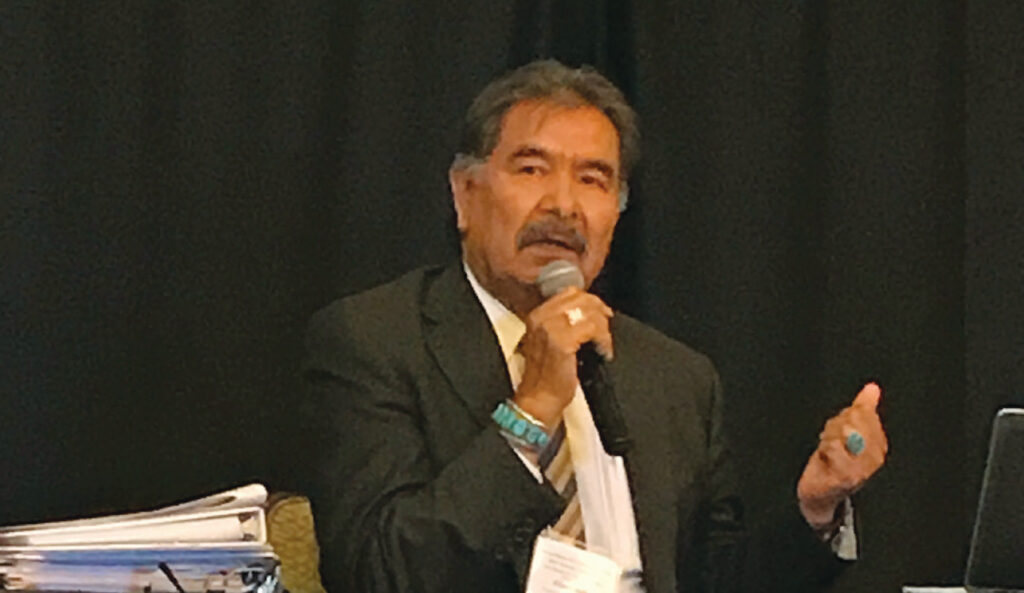
Founding NNBA President Albert Hale
Tested Topics on the Current NNBA Bar Exam
- Civil Procedure
- Criminal Law and Procedure
- Torts
- Contracts
- Evidence
- Probate
- Family Law
- Navajo Fundamental Law (Diné Bi Beenahaz’aanii)
- The Navajo Treaty of 1868
- Navajo Nation Government
- The Navajo Bill of Rights
- Navajo Peacemaking
- Navajo Personal and Real Property
- Navajo Rules of Professional Conduct
- Federal Indian Law
A Global Pandemic Hits the Navajo Nation Hard
By early 2020, the NNBA—with more than 500 members—had become the largest nonprofit legal services organization in the United States directly serving a federally recognized Native American tribe. The Navajo Nation’s population grew dramatically during this same period. The BIA currently estimates the Nation’s total enrolled membership at 427,414 persons; roughly 165,000 members lived on the Navajo Reservation according to 2020 census data.9
NNBA has weathered many challenges since its inception, but perhaps none hit harder than the global COVID-19 pandemic. Much of “Indian Country”—the term used for Native American tribal homelands according to federal law—experienced disproportionately higher rates of infection.
COVID-19 was first reported on the Nation on March 17, 2020. By May 11 of that year, the Nation reported a higher per capita infection rate than any US state.10 By January 2025, the number of confirmed COVID-19 cases originating in the Navajo Nation was 93,980, with 2,334 deaths.11 Tragically, COVID-19 claimed the lives of at least 17 NNBA members during this period, including Albert Hale, who passed due to complications from the virus in 2021 at age 70. More than 150 NNBA members said they were permanently retiring from law practice at the same time, many of them either becoming inactive NNBA members or resigning from the association.
During the pandemic, the Navajo Judicial Branch faced an unprecedented public health crisis. The lack of internet infrastructure meant that virtual courtroom options were often limited or unavailable. Whereas some District Courts continued to operate in person, others, such as the Shiprock Judicial District, were compelled to shut down for extended periods due to the high rates of infection and limited medical care available on the Nation. Conversely, pro bono court appointments by some courts posed unique challenges. Since the Nation was legally closed to outside visitation for several months during the pandemic, some NNBA members appointed to pro bono cases had to obtain an exemption to travel there. Lodging was typically unavailable when families were sheltering in place and motels were closed. Sometimes camping near the courthouse or sleeping in parked vehicles were the most viable options given the situation. The NNBA Bar Exam did continue with social distancing between 2020 and 2022, albeit with fewer candidates than usual, mirroring the lower numbers of the association’s earlier days.
Looking Forward
Four years since the pandemic’s height, NNBA’s total membership has most recently stabilized at around 300 total members. Newcomers—typically recent law school graduates—have joined the association at roughly the same rate as veteran NNBA members have retired. For instance, during the March 2026 bar exam, 9 examinees passed out of 12 total. This essentially matches the number of NNBA members who are retiring from law practice or otherwise stepping away from bar membership this year.
Looking forward, one promising development has been an emerging partnership between the NNBA and Arizona State University’s Sandra Day O’Connor College of Law. The two institutions joined forces to sponsor this year’s annual NNBA conference, held at the law school. Additionally, ASU hosts a one-day Navajo Law Conference every fall where NNBA members may obtain CLE credits. This collaboration builds on ASU’s flagship program in Federal Indian Law, which has recently been expanded to include a master of legal studies program with an emphasis in Navajo Law. This is a special program in collaboration with Diné College, a Navajo-led educational institution located on the Reservation.
For those practicing law in the Navajo Nation courts—and the individuals and families who rely on them—it is difficult to overestimate the foundational importance of the NNBA to the rule of law in the country’s largest tribal homeland. This grassroots, Navajo-created organization, bringing together Diné citizens, members of other Native American tribes, and non-Indians aspiring to be of service to the Navajo people, effectively models, enforces, and elevates the practice of law across a geographical area that is larger than 10 US states. Not only that, but NNBA provides a continuing source of legal representation, including on a pro bono basis, to some of the most economically challenged communities in the United States.
Notes
- Half of all Native American attorneys who have practiced since the mid-1960s have attended the PLSI. Created to be a pipeline to increase the role and influence of Native American and Alaska Native law students and attorneys, approximately 90 percent of the over 1,000 PLSI alumni have gone on to graduate from an ABA-accredited law school. See Jordan Oglesby, “Pipeline to Tribal Sovereignty: Celebrating the Pre-Law Summer Institute’s 50th Class,” 66 The Federal Lawyer 59–61 (March/April 2019), available at https://www.fedbar.org/wp-content/uploads/2019/03/Oglesby-pdf-1.pdf. (Go back)
- Author’s notes, interview for the 2020 Navajo Nation Bar Association annual conference, May 28, 2020. (Go back)
- Enacting the Judicial Reform Act of 1985, Amendments to Title 7, Navajo Tribal Code, CD-94-85 (December 4, 1985). (Go back)
- For a detailed account of this judicial transformation, see Chief Justice (Emeritus) Robert Yazzie, “History of the Courts of the Navajo Nation” (February 11, 2003), available at https://courts.navajo-nsn.gov/history.htm. (Go back)
- For attorneys looking for a resource on Diné Bi Beenahaz’aanii and its role in modern jurisprudence and governance, see Raymond D. Austin, Navajo Courts and Navajo Common Law: A Tradition of Tribal Self-Governance (University of Minnesota Press, 2009). (Go back)
- See the NNBA bylaws at https://www.navajolaw.info/bylaws. (Go back)
- Eight CLE hours are required annually, with at least 2 in Navajo Ethics and 6 in Navajo Law. (Go back)
- Supra note 1. (Go back)
- “Navajo Nation Enrollment Continues to Grow, Reflecting the Strength of Our People” (June 6, 2026), available at https://opvp.navajo-nsn.gov/260608-navajo-nation-enrollment-continues-to-grow/; Navajo Department of Health, “Navajo Nation Population Profile: U.S. Census 2020” (July 2024), at 16, available at https://nec.navajo-nsn.gov/Portals/0/Reports/Navajo%20Nation%20Population%20Profile%202020.pdf. (Go back)
- Rebecca Klar, “Navajo Nation Reports More Coronavirus Cases Per Capita Than Any US State,” The Hill (May 11, 2020), available at https://thehill.com/policy/healthcare/497091-navajo-nation-has-more-coronavirus-cases-per-capita-than-any-us-state/. (Go back)
- Navajo Department of Health, “Navajo Nation Dikos Ntsaaígíí-19 (COVID-19) Monthly Report 946” (January 1, 2025), available at https://nec.navajo-nsn.gov/Portals/0/COVID-19/NN-SIT-COVID19-946.pdf. (Go back)
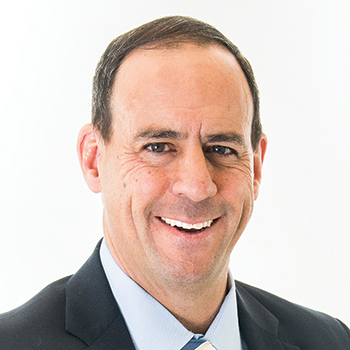 Troy A. Eid is a principal shareholder with Greenberg Traurig LLP in Denver. He served as Colorado’s 40th US Attorney, appointed by President George W. Bush, and as the Chairman of the Indian Law and Order Commission under President Barack Obama. He served two terms as the elected President of the NNBA (2018–2022) and is currently NNBA’s elected Commissioner for the Shiprock District Court. He can be reached at eidt@gtlaw.com.
This article originally appeared in The Bar Examiner print edition, Fall 2026 (Vol. 95, No. 3), pp. 14–18.
Contact us to request a pdf file of the original article as it appeared in the print edition.