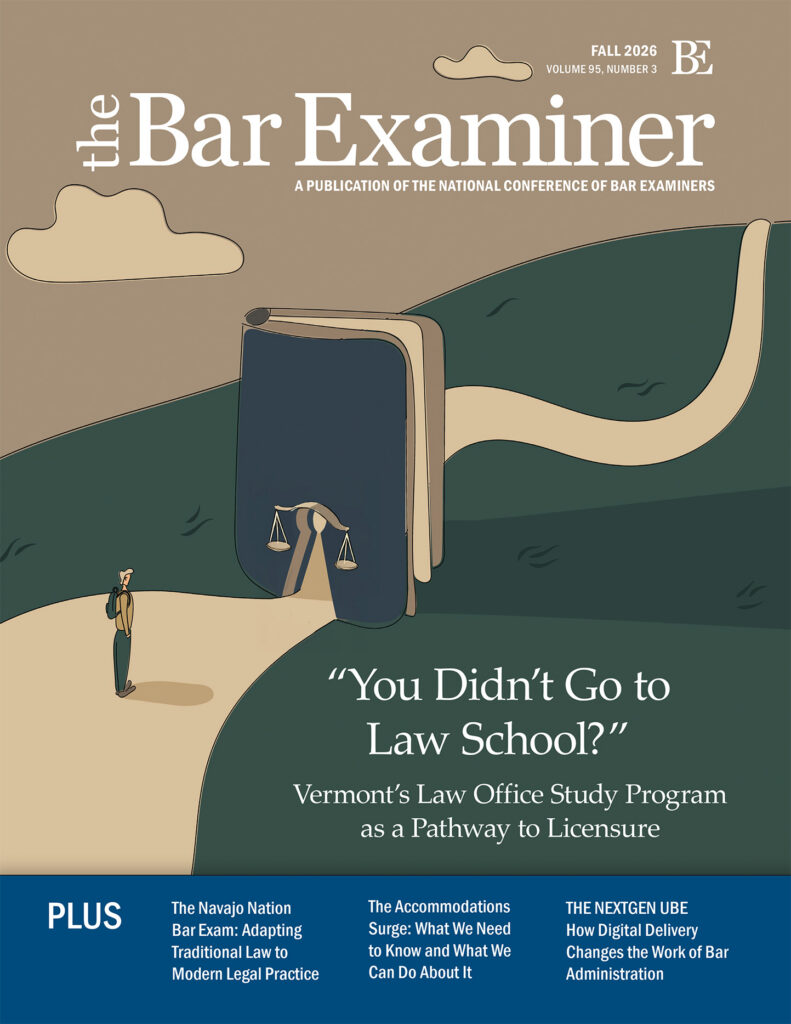
By Sam Abel-Palmer and Patty Turley Attorneys often field a question: Where did you go to law school? But in Vermont, you would not be surprised if a lawyer answers that they did not attend law school. Vermont is one of a few US jurisdictions that provides a pathway to bar licensure akin to the clerkship or apprenticeship model. Vermont’s Law Office Study (LOS) Program is active, and the Vermont bar rolls have many attorneys licensed by this approach. The LOS Program offers a robust pathway to bar licensure via a four-year, self-guided course of study before participants sit for the bar exam with the opportunity to become fully licensed to practice law in Vermont. These attorneys are accepted by the Vermont legal community and practice in the state without differentiation, reaching the highest levels. We want to share how this program works.
Sam’s Story
Sam Abel-Palmer is executive director of Legal Services Vermont (LSV), the state’s Legal Services Corporation (LSC) grantee,1 a position he has held since 2016. Law is Sam’s second career. His first was as a professor of theater history, so returning to full-time graduate study was not a feasible option. He enrolled in Vermont’s LOS Program in 2002 while working as an investigator with the Vermont Human Rights Commission (and parenting three small children) and was admitted to the Vermont Bar in spring 2006. Prior to his current position, he served as director of intake for Vermont Legal Aid (VLA; LSV’s non-LSC partner agency) and as a staff attorney in that organization’s Disability Law Project.
Patty’s Story
Patty Turley’s journey to becoming a lawyer began as a senior in high school, when she began working for a law office in Montpelier, Vermont. She ran errands to the law library, did lots of filing and copying, and eventually undertook some light bookkeeping. One of the firm’s partners encouraged her to train in-house as a paralegal, mentioning that if it went smoothly, she might “read law” in the future.2 Paralegal work suited her very well, and, with a growing family, Patty was unwilling to leave her job to attend law school. When other attorneys in the firm also encouraged her to consider the LOS Program, she registered in fall 1994. After completing the program four years later, she successfully sat for the bar in February 1999. Patty went on to spend more than twenty years in private practice with the same law firm where it all began. Patty is now General Counsel for the Vermont State Colleges.
How the Program Works
The requirements of the Vermont LOS Program, which are set out in Rule 7 of the Vermont Rules of Admission, are straightforward.3 To be eligible to register for the program, a person must hold a bachelor’s degree from an accredited undergraduate program; registrants with degrees granted outside the United States must demonstrate a comparable level of undergraduate study. The registrant must also identify a supervisor, who must be an attorney or judge who has been licensed to practice in Vermont for at least three years. Both the registrant and the supervisor must fill out a one-page form certifying their intent to pursue the program. The registrant pays an initial $200 fee at registration, and a $100 fee at the time of filing each six-month report, for a total cost of $1,000 over the course of the program.
…people in the program typically use a mix of legal work hours and personal study time outside their employment.
The general requirement for program participants is four years of full-time study. One week of study is defined as a minimum of 25 hours over seven days, or 30 hours over 14 days, and participants must complete a minimum of 44 weeks of study during the year. There are few rules about how those hours are counted, but people in the program typically use a mix of legal work hours and personal study time outside their employment. Participants may request up to two years of credit for prior study, typically for those who have completed some law school classes but have not received a JD. Participants must submit evidence of the prior study, which is then reviewed by the Board of Bar Examiners. The board also reviews any other requests for waivers or modifications to the program.
Each six-month progress report participants submit includes a sworn affidavit attesting that they have completed the required hours. The report also includes an overview of subjects that the participant has covered during the relevant period, a list of readings, tasks completed for their supervisor, practical attorney skills they have engaged in, and a plan for the next six months of study. These reports are reviewed and signed by the supervising attorney and then submitted to the board.
There are no formal rules for how each registrant and supervisor craft the course of study. Participants are provided with a broad outline of the topics that should be covered (recently revised to reflect the NextGen UBE, which Vermont will begin to administer in 2027).4 Participants are encouraged to obtain study materials equivalent to those they would use in law school and to plan out their studies to cover all substantive subjects in depth while allowing time for exam preparation. The Vermont Bar Association also offers overview continuing legal education (CLE) sessions in many substantive areas geared toward LOS students. Ideally, the course of study works similarly to a law school curriculum, with participants focusing on each area of substantive and procedural law sequentially during the four-year study period. Participants are encouraged to study subjects at an equivalent depth as a law school course, including reading hornbooks and outlines, reviewing case law, and practicing legal research and writing skills.
At registration, each participant is assigned to a member of the Board of Bar Examiners who is anonymously responsible for monitoring the participant’s progress. The participant’s six-month reports are reviewed by the assigned bar examiner. The examiner may pass a report as is or suggest how the participant can improve their study. Such suggestions, for example, may touch on expanding a candidate’s independent study beyond the areas of law covered through their employment or encouraging the candidate to be more specific about research sources they have consulted. Conversely, the examiner may reject a report, requiring the participant to engage in another period of study beyond the standard four-year timeline. Rejections are rare, however, and often come only if the participant has ignored advice from earlier deficient reports.
Program Benefits
There are some tremendous benefits of the LOS Program. One of the greatest assets is the program’s ability to allow paralegal staff to break through a glass ceiling. There is an almost inevitable hierarchy built into the structure of any law firm separating the practicing lawyers and such staff. As an example, two recent graduates of the LOS Program on Sam’s staff started at VLA in secretarial positions, moved into paralegal work there, completed the program, and then joined LSV as staff attorneys after passing the bar exam. The program has undoubtedly allowed talented people to remain with these public offices rather than forcing them to leave to attend law school. For private firms, when an LOS participant moves from a support staff role to that of an associate attorney, there is often little training needed for the new lawyer to adapt to the law firm environment, especially compared to recent law school graduates who may have limited exposure to law office culture.
The other substantial benefit is the very low cost of the program. Law school tuition typically runs $50,000 per year. Once you include living expenses, those three years can cost up to $300,000. For anyone with a low or moderate income, law school is often simply not an option. By comparison, the LOS Program costs $1,000 plus any books you buy. For people like Sam, who came to law as a second career, this path presented a unique opportunity. The LOS Program allowed him to enter this career path while maintaining full-time employment. Similarly, Patty did not have to leave a job she loved for the uncertain and expensive experience of law school. Someone who is not completely sure about becoming an attorney would understandably be reluctant to interrupt their personal and professional lives and incur the expense of enrolling in law school. But someone who starts the LOS Program and finds themselves unsuited to that path can stop with little negative impact. For the above reasons—and to Vermont’s benefit—the LOS Program is a tremendous tool to help bring people from varied backgrounds into legal work.
Program Limitations
Licensure Portability
On the downside, although LOS graduates are fully licensed attorneys in Vermont, the lack of a JD via the pathway can be an issue. Vermont’s Rules of Admission have flexible education requirements, but most US jurisdictions explicitly require a JD for bar admission by examination. The transferability of Vermont’s LOS licensure is largely untested; most people who complete the program do so because they have close ties to their community and have no intention of practicing in another jurisdiction. Vermont has a reciprocal licensing agreement with Maine and New Hampshire, but for other jurisdictions, acceptance of the LOS Program as adequate preparation is likely a matter of discretion for the jurisdiction’s licensing office. Anyone completing the program in Vermont may face challenges if they want to transfer their license to another jurisdiction.
Time Commitment
Another downside is the time commitment. Although many LOS participants work in the legal field, those job hours don’t usually count for hours studied. Indeed, a participant likely must dedicate many independent hours each week to studying topics not covered (or not covered deeply) via their regular work responsibilities. It is important for the participant to engage in study time beyond the employment context. A participant who works in a full-time legal environment could, technically, meet the minimum hours requirement solely with time on the job. And a skilled paralegal will undoubtedly pick up much valuable information and develop effective skills in their work. But no one law practice, however broad in scope, is going to encompass the full range of substantive law knowledge necessary to pass the exam. A participant is not going to pick up, say, constitutional law or wills and estates just by attending a general CLE or reading a one-volume outline.
Participants need to devote off-work hours to replicate the kind of study they would pursue in law school, especially via working through the cases and precedents necessary to provide effective answers on exams. Working full-time and being an LOS student is likely a larger time commitment than attending law school full-time. And once the LOS Program is completed, the typical participant likely won’t have weeks of bar preparation time free from their job, as some law school graduates do.
Availability of Supervising Attorneys for the Program
Another practical downside is that people who are interested in participating in the program may lack a connection to a potential supervising attorney. Most supervising attorneys work with and know the participant prior to sponsoring them in the LOS Program.5 The best solution is for prospective participants to get their foot in the door working in a legal office to gain experience and develop relationships with attorneys.
Commitment by the State and Bar
There is a time commitment from the Office of Attorney Licensing and the bar examiners, but it is modest and manageable. The office reviews applications, approves registrants and their supervising attorneys, assigns examiners, and monitors the six-month progress reports. Reports get forwarded to the assigned examiner. As mentioned above, examiners analyze six-month reports for approval or rejection and often provide substantive feedback. Most examiners handle six or so participants at any one time. To maintain examiner anonymity, all examiner and participant communications route through the Office of Attorney Licensing. The office also provides resources for participants, including NCBE information and CLE offerings.6 One focus of the office is to develop strategies to increase LOS participants’ bar passage rate, a topic discussed in greater detail below. The Office of Attorney Licensing has also encouraged the legal community to focus their support for LOS participants, which has led to an email group for discussion, specific CLEs, and the newly established Law Office Study section of the Vermont Bar Association. These administrative responsibilities are upheld knowing the importance of maintaining this longtime Vermont pathway to licensure.
The Vermont legal community accepts the program and its graduates, recognizing the comparable education and training that has been achieved.
Besides Vermont, five other US jurisdictions currently allow for some kind of law office study: California, Maine, New York, Virginia, and Washington state. Each program has its own procedures and rules, and there is little consistency of practice between them. Although Vermont is the smallest of these states, it has by far the highest percentage of exam takers who go through such a program. Based on NCBE statistics, in Vermont, 17% of all people taking the bar exam (15 out of 88) in 2025 went through the LOS Program.7 By comparison, in Washington that number was just under 4%; in New York, Virginia, and California they represented a fraction of 1% in each of those jurisdictions.8 Over a ten-year period, Vermont’s first-time exam pass rate for LOS participants is a respectable 54%, according to internal data maintained by the state’s Office of Attorney Licensing. Although Vermont LOS passage rates are often somewhat lower than the state’s general pass rate for law school graduates, Vermont benefits because, practically speaking, these new attorneys are committed to staying in the state.
These statistics prompt one question: Why does Vermont have so many more people who pursue law office study? There has been no formal research on the topic, but there is little doubt that networking and word-of-mouth encouragement have much to do with it. The Vermont legal community accepts the program and its graduates, recognizing the comparable education and training that has been achieved.
Historically, there has been a strong affinity in Vermont between the LOS Program and public interest law. Participants in the program may come to law later in life or have nontraditional backgrounds where their life experiences resonate with legal aid clientele. Legal aid and state government offices often provide an environment that is less competitive and more likely to support and nurture office staff who are in paralegal roles, providing them the flexibility and support to pursue this path. On a practical level, a person working as a paralegal, especially on a nonprofit pay scale, may not have the means to attend law school, whereas people who graduate law school with hundreds of thousands of dollars in student loan debt may not be able to accept lower-paying legal jobs, no matter how much they are attracted to the work.
What Makes for a Successful Law Office Study Experience?
Given the flexibility of the LOS Program, it’s a little tricky to generalize about what factors make the program successful. There are, though, certain factors that seem important in crafting an independent study program that successfully leads to licensure. Not every program will employ all these tactics, but our personal experience reviewing LOS reports indicates that these are certainly helpful strategies for anyone looking to prepare for the bar this way.
The first critical factor is for the participant to have some kind of legal employment or exposure to the field, preferably during the study period. Working in a law office allows the participant to absorb the language (and jargon) of the law and observe how lawyers think and work. Given the broad range of legal problems that come through its doors, a legal aid office can be an ideal setting in this respect for someone in the program. Although the vast majority of participants work in a legal environment, there are occasionally individuals who meet the study requirements without this experience.
Another important factor in success is active supervisor engagement. There is no official requirement for what the supervising attorney does other than signing off on the six-month reports. But experience indicates that a successful participant gets regular and active assistance from the mentoring attorney. The supervisor should meet regularly with the participant, provide guidance around subjects to study and resources to use, assign important case law to review, and otherwise offer active guidance and support. The support network can also be broader. For example, an LOS graduate on Sam’s staff worked with his direct supervisor as a primary mentor but also spent many hours shadowing a volunteer attorney who ran a pro bono walk-in clinic. Sam and Patty have similar stories of support that went beyond their supervisor.
Another success factor is that the participant would preferably have some prior research and independent learning skills. The LOS Program has no specific resources for learning legal writing and research skills other than mentorship from the supervisor.
Probably the most critical of these skills is the need for rigorous self-discipline to stay focused on the study program week after week for four years. It is not uncommon for participants to take a break, or drop out altogether, due to personal or family circumstances that interrupt the original study plan.9
Certainly, one of the advantages of going to law school is being among other students all working toward the same goal. And one of the downsides of the LOS model is potential isolation, especially if the participant is working in a high-pressure environment with no one else doing the same kind of study. Ideally, the participant will find a group of people for support and guidance, whether it’s others enrolled in the program or mentors in their firm or elsewhere. When Sam was in the program, another paralegal working in a nearby state office was also enrolled. They were able to meet together with their supervisors for lunch several times a month to review substantive materials and discuss concepts. Patty also relied heavily on coworkers in her law firm, including some recent law school graduates, who were generously interested in reviewing cases and talking through ideas. However organized, it is helpful to have emotional and moral support throughout the program. The previously mentioned email group and dedicated LOS section of the state bar association help foster these connections.
Finally, one factor to ensure success beyond the program is building in time to prepare for the bar exam. Exam preparation can take place between formal completion of the program and sitting for the exam, much the way many law school graduates prepare post-graduation. Since many LOS participants are working, it may be challenging to step away, but it is important to prepare. Patty, for example, took a few mornings per week off from work at the firm for dedicated study time prior to the exam. Sam’s agency, by comparison, offers first-time examinees four weeks of paid leave for bar exam study, whether an LOS participant or a recently hired law school graduate.
Conclusion
Vermont’s Law Office Study Program can serve as a national model for another route to law licensure. The program provides an effective pathway into the profession while avoiding the daunting (and rising) cost of law school. As many recent studies have shown, the bar nationally is aging, and many areas are finding it hard to attract new lawyers.10 Small law firms can struggle to offer compensation that will allow a new attorney to pay their student loans. Legal deserts in rural areas also pose a serious challenge. Many legal aid agencies in recent years have left positions unfilled due to a lack of qualified applicants, even when funding is available. High debt load certainly prevents many new lawyers from working in legal aid offices or at small rural firms, even if they have a passion for the work or community. As we look at ways to sustain legal work through difficult times, Vermont’s LOS Program provides another way to maximize our resources, and to attract and retain talented staff who are committed to access to justice for all.
Notes
- The Legal Services Corporation administers federal congressional funding of free legal services for low-income Americans. See https://www.lsc.gov/ for more information. (Go back)
- Patty also earned her bachelor’s degree while working at the firm; the LOS Program did not require one at the time, but she decided that finishing her bachelor’s degree would be an important step prior to undertaking such studies. (Go back)
- See Rules of Admission to the Bar of the Vermont Supreme Court, available at https://www.vermontjudiciary.org/sites/default/files/documents/900-00014%20-%20Rules%20of%20Admission%202025.01.01.pdf. For more information about Vermont’s Law Office Study Program, see also Vermont Judiciary, The Law Office Study Program, available at https://www.vermontjudiciary.org/attorneys/law-office-study-program. (Go back)
- An outline of subjects can be found in the six-month report forms at https://www.vtcourts.gov/attorneys/law-office-study-program. (Go back)
- There are currently no restrictions on familial relationships between a supervising attorney and candidate. (Go back)
- See Vermont Judiciary, The Law Office Study Program, available at https://www.vermontjudiciary.org/attorneys/law-office-study-program. (Go back)
- See “Persons Taking and Passing the 2025 Bar Examination by Source of Legal Education,” 95(1) The Bar Examiner 13–14 (Spring 2026). (Go back)
- The programs in Maine and New York require some attendance at a law school, with independent study as a means to finish the education process. California, Vermont, Virginia, and Washington do not require any law school attendance. Maine did not have any 2025 examinees via law office study. (Go back)
- The board considers all candidate requests for a leave of absence and/or return to the program after a period of time on an individual basis. (Go back)
- The median age of a lawyer in 2023 was 46, up from under 40 in 1980. See ABA, “Profile of the Legal Profession 2024: Demographics,” available at https://www.americanbar.org/news/profile-legal-profession/demographics/; on challenges facing rural communities, see Legal Services Corporation Rural Justice Task Force, “Justice Where We Live: Promising Practices from Rural Communities” (October 2025), available at https://www.lsc.gov/ruralreport. (Go back)
 Sam Abel-Palmer is Executive Director of Legal Services Vermont.
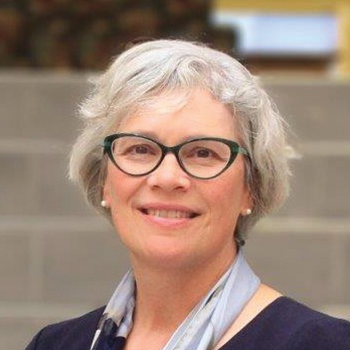 Patty Turley is General Counsel for the Vermont State Colleges.
This article originally appeared in The Bar Examiner print edition, Fall 2026 (Vol. 95, No. 3), pp. 7–13.
Contact us to request a pdf file of the original article as it appeared in the print edition.